
After Grade 8 Piano: Preparing for Diploma-Level Study
Finishing Grade 8 piano changes the shape of the question. For years, the next step may have been another grade, another syllabus and another set of pieces. Now there is a much larger field of music to choose from, and the next meaningful goal may take longer to define. A performance diploma is one possible direction. So are chamber music, a personal recital, broader repertoire study or preparation for a conservatoire audition.
The main change in diploma-level study is the responsibility you take for a sustained performance: choosing a programme, understanding its styles, making musical decisions and keeping those decisions alive from beginning to end. Learning a harder piece is part of that work, but it does not contain all of it.
- Choose the purpose of your next period of study before choosing an exam date.
- Read the requirements of the exact diploma and assessment route you are considering.
- Develop a programme with contrast, musical shape and demands you can sustain.
- Test your preparation through complete performances as well as detailed practice.
Grade 8 and the next decision
A Grade 8 result records an achievement in a particular examination. It is also a useful moment to look beyond the pieces that received most of your attention. You may have a convincing lyrical sound but limited experience of contrapuntal music, where several melodic lines move together. You may learn notes quickly but depend on a teacher to decide every tempo change. Another pianist may have strong musical ideas yet struggle to sustain a longer performance.
I have taught ABRSM candidates through Grade 8, including students who have received Merit results. After an exam, I want to hear what remains alive in the playing and what the student wants to explore next. Sometimes the most useful work is a larger programme. Sometimes it is a period of learning unfamiliar music more independently, away from an immediate examination deadline.
Begin with that musical assessment. Play something recently prepared, bring a piece at an earlier stage, and discuss how you work between lessons. A teacher can hear both the standard of the finished playing and the process behind it. Those two views help determine the next repertoire and the kind of support you need.
A diploma is a separate qualification, not a university degree or an automatic conservatoire place. If your goal is degree study, the course's academic, language and audition requirements still apply. A diploma programme can overlap with that preparation, but it should be checked against the particular audition rather than treated as a substitute for it.
ARSM and ATCL routes
Two possible first performance diplomas are ABRSM's ARSM and Trinity College London's ATCL. Their requirements differ. ARSM normally requires the relevant ABRSM Grade 8 Practical or Performance qualification, with accepted alternatives listed in the specification. Trinity's performance diplomas have no requirement to have passed a previous qualification. In either case, the musical demands deserve an assessment before you enter.
ARSM centres on a recital of about half an hour. ATCL asks for 32–38 minutes of performed music. The way time is counted also matters: ARSM includes the transitions between pieces, whereas Trinity excludes pauses between complete works. Build the programme using the rules of the chosen board from the outset.
The comparison below covers planning points, not every entry condition. Read the current specification and piano repertoire list together, including the rules for complete works, movements, repeats and the assessment format. If you are considering a higher diploma, open its own requirements rather than extending the first diploma's rules by assumption.
ABRSM ARSM
- Timing
- 30 minutes, with a tolerance of two minutes either way. Transitions between pieces count in the timing.
- Repertoire
- Use listed repertoire for 20 minutes or more. An own-choice allowance of up to 10 minutes is available for music at Grade 8 standard or higher.
- Own-choice planning
- ABRSM does not give advance approval for own-choice works. Check the specification’s programming conditions before choosing them.
Trinity ATCL
- Timing
- 32–38 minutes of performed music. Pauses between complete works are excluded.
- Repertoire
- Include at least two works and a varied programme. Choose from the ATCL list, approved own-choice repertoire, or a combination.
- Own-choice planning
- A programme containing own-choice music needs Trinity’s approval before entry. Follow the requirements for complete works and listed movements.
For Trinity solo piano diplomas, the current piano list requires an acoustic grand or upright piano; a digital piano is not permitted for the assessment. That affects the performance venue or recording arrangements even if some preparation takes place on a digital instrument. Confirm access early enough to become familiar with the sound and response of the assessment instrument.

One-to-one classical piano
Beginner to advanced. Online, worldwide.
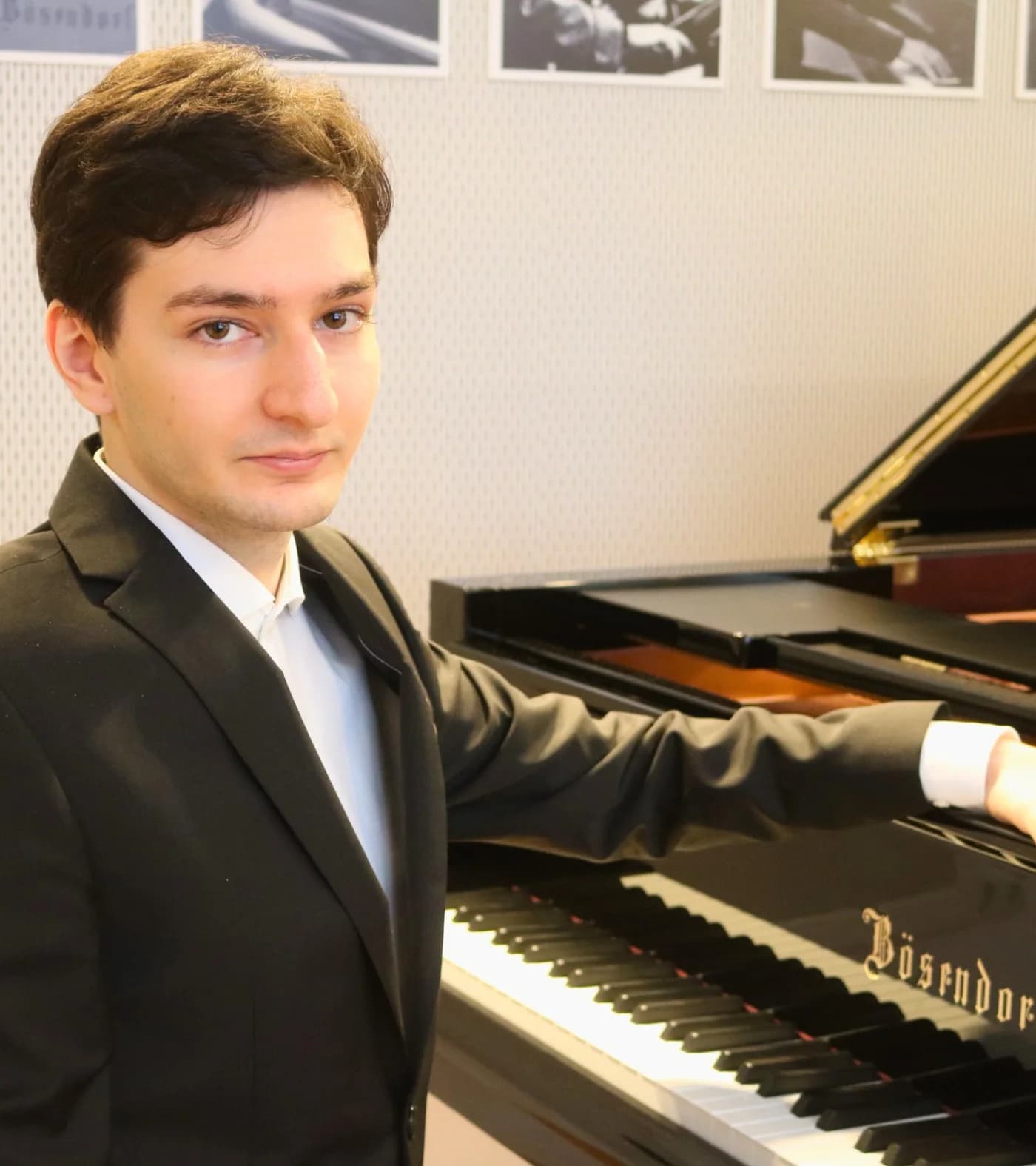
Enea
Concert pianist from Vienna
30 minutes · Ikebukuro & Shinjuku studios from October 2026
A programme with an arc
Start by asking what each work contributes. One piece may establish clarity and rhythmic energy; another may ask the listener to follow a long melodic line; a third may introduce a different texture or harmonic language. A programme should make sense as a sequence of musical experiences, as well as meeting the board's repertoire requirements.
Contrast is more than a list of historical periods. Two pieces from different centuries can still ask for very similar textures and gestures. Conversely, two works by near contemporaries may call for sharply different kinds of listening. Consider tempo, density, register, length and character, then hear how the ending of one work prepares the ear for the beginning of the next.
Imagine a programme whose three main pieces all depend on a prominent right-hand melody above a flowing accompaniment. Each may be attractive, yet the whole recital may reveal a narrow part of your playing. A work with independent voices or a more sharply articulated rhythmic character could broaden the musical conversation. The exact choice must still fit the repertoire rules and your present preparation.
Avoid making every piece the most demanding work you have ever attempted. A programme needs room for musical authority: passages where your attention is free to shape a phrase, hear a balance or respond to the instrument. The guide to choosing a classical piano piece at the right level considers the demands within a work; at diploma level, apply that judgment to the combined programme too.
Style in the sound
Stylistic understanding becomes audible through decisions. How does a cadence settle? Which voice carries the argument? How much separation gives a short motif its character? A historical label on the programme tells the listener little unless the playing expresses the differences.
In a contrapuntal passage, follow one voice through several entries while playing the complete texture. Notice where a line passes from one hand to the other, or where the left hand carries the more important event. If every right-hand note receives the same prominence, the listener may lose the conversation between voices. Practising each line separately is useful, but the final test is whether you can still hear it among the others.
In a Classical movement, experiment with the relationship between a short slur and the longer phrase. A small release at the end of the slur should not necessarily become a pause in the musical sentence. Play the passage with exaggerated separations, then with almost none, and listen for a version that gives the motif definition while preserving direction. The score and the surrounding musical context should guide that choice.
In a lyrical Romantic texture, listen to the bass as well as the melody. A change of harmony may call for a different colour or a slight change in pacing, while repeated accompaniment patterns still need continuity. If each expressive moment interrupts the underlying movement, the phrase can become a collection of attractive fragments. Record a longer span and hear whether the destination remains clear.
These examples are ways of investigating a score, not uniform rules for whole periods. Different works ask different questions. The purpose of stylistic study is to make a more informed choice in the music in front of you.
Independent score work
At this stage, arriving with accurate notes is the beginning of a lesson. Bring a view of the piece: where its main sections lie, which passages return, where the harmony changes direction, and what remains uncertain. Your first interpretation can change. Having one gives the discussion something to test.
Compare repeated passages carefully. The notes may resemble an earlier section while the register, harmony or dynamic context has changed. Ask what the return means at this point in the work. A passage that sounded exploratory at the opening may sound settled, strained or transformed later. The answer should emerge through the score and your listening, not from an expressive story added independently of the music.
Use recordings as questions rather than templates. Compare two performances of one passage and name the difference you hear: a steadier bass, a later relaxation, a more distinct inner voice. Then try the alternatives yourself. Decide which one explains the passage most convincingly on your instrument and at your current level of control.
An edition can also contain different kinds of information. Check the preface and editorial notes when markings are bracketed or alternatives appear. If you are unsure whether a fingering or dynamic comes from the composer or editor, bring that question to the lesson. Independent study includes knowing where your information comes from and recognising when a detail needs further investigation.
From pieces to a recital
A piece that works beautifully on its own may feel different after twenty minutes of playing. Your attention has already travelled through other music, your ear has adapted to another sound world, and the next opening has to establish its character promptly. Rehearsing the programme reveals these relationships.
Begin by pairing works. Play the end of one, allow an appropriate pause, and begin the next. Hear the difference in pulse and sound before touching the first key. Later, perform the entire sequence and listen to whether the final work receives the same care as the first. This is preparation for communication across a programme, not simply an endurance test.
Separate performance attempts from correction sessions. During a run, continue through a recoverable slip and preserve the musical line. Afterwards, identify the passages that need detailed work. Repeatedly restarting the programme at the first error teaches a different task from carrying a performance to its conclusion.
A mock recital can include a small audience or a recording, with feedback on the whole experience. Ask where concentration or musical direction weakened, as well as where notes went wrong. The mock piano audition and feedback guide offers a way to organise that feedback; adapt the setting and programme to the diploma you are preparing.
Each work
- Question
- Can I explain and play its main musical shape?
- An example of audible evidence
- A recording shows the return of the opening idea with a deliberate change in colour.
- A possible next task
- Compare the two passages in the score, then test the balance and timing in context.
Between works
- Question
- Does the next opening establish a different character?
- An example of audible evidence
- The slow work begins at the previous piece’s pace, despite being secure on its own.
- A possible next task
- Practise the previous ending and the new opening together, hearing the new pulse during the pause.
The complete programme
- Question
- Does the final work retain clarity and direction?
- An example of audible evidence
- The last performance loses inner-voice detail that was audible in separate practice.
- A possible next task
- Review tempo, workload and focus with the teacher, then test the whole sequence again.
Use the worksheet for your own programme
Programme and order: ____. Date and setting of performance: ____. One musical feature that held across the recital: ____. One passage or transition that changed under performance conditions: ____. What I heard: ____. My next practice experiment: ____. Review the evidence with your teacher before choosing a booking date.
A broader musical life
Keep some music outside the diploma programme. Reading a shorter piece, accompanying a singer or playing chamber music can expose habits that a familiar solo programme no longer reveals. Following another musician's breath or timing asks you to listen in a different way. Reading fresh material shows whether your understanding extends beyond pieces learned in detail.
Technical work should respond to what the repertoire asks. If a passage needs a quiet, even accompaniment under a sustained melody, choose practice that addresses balance and continuity. If a leap repeatedly disrupts the pulse, study the movement and the musical event at the arrival. A long list of exercises is less useful than a clear connection between the exercise and the sound you want.
There is also value in returning to an earlier piece with new ears. A work below the technical level of your diploma programme may reveal how much control you have over timing, articulation and tone when the notes are secure. Musical maturity is not confined to difficult repertoire. The freedom to shape a modest piece can be one of the clearest signs that your playing has developed.
If the next exam is not yet the right goal, choose another defined project: a short recital, a group of contrasting works, or a period of chamber music. Give it a performance or listening outcome that can be reviewed. Continuing seriously after Grade 8 can take more than one form.
Planning the next lessons
Bring your Grade 8 repertoire, any available feedback, and the music you are considering next. Tell the teacher whether the goal is a particular diploma, a recital, broader study or a future audition. If a diploma is already in view, include the exact board and route so that programme choices begin with the correct requirements.
In lessons, I want to hear both a prepared performance and the questions behind it. We might work on the shape of a longer movement, the balance between voices, or the difference between two possible readings of a phrase. The plan should leave space for these musical decisions, alongside a realistic account of learning time and performance preparation.
Vienna Piano School teaches learners from junior-high-school age through adulthood, including advanced classical pianists. Lessons in English are available online, with in-person lessons at piano studios in Ikebukuro and Shinjuku, Tokyo, from October 2026. You can request a free 30-minute trial lesson to discuss your playing and the next programme you want to build.