
ABRSM Piano Sight-Reading: Preparation Time, Pulse and a Practice Score

ABRSM piano sight-reading begins before the first note. In a Practical Grade, the standard preparation time is half a minute, and you may use it both to look through the music and to try any part of it at the piano. The useful question is what to notice during those thirty seconds so that the passage has a shape when you begin.
I listen for that shape from the outset: a pulse that carries the phrase, a bass note held for its full length, a melody that reaches its destination. A hesitant reading often contains more correct notes than the player realises. The trouble is that each note has become a separate decision, with silence between decisions.
This guide covers the exam task, how to prepare for it and how to work with a fresh eight-bar example. If you are taking a Performance Grade, sight-reading is not a separate assessed component; our comparison of Practical and Performance Grades explains the difference.
Preparation and performance
- Know the scope
- Check the keys, metres and textures for your grade in the official specification.
- Use the 30 seconds
- Survey the whole passage, then try a rhythm or hand movement that needs attention.
- Make a performance
- Read pitches and durations while sustaining the pulse and the phrase.
The task and your grade
The Practical sight-reading test is a short, unseen, unaccompanied passage. Its scope changes with the grade. Use the sight-reading pages in the syllabus applicable to your exam, including their notes about features carried forward from earlier grades. Reading only the new row can leave gaps in your preparation.
For the worked example here, Grade 3 provides a useful reference point. The 2027–2028 specification allows passages of up to eight bars, movement outside a five-finger position and two-note chords. G major and 3/4 remain within its cumulative range. Other keys, metres and rhythmic features are possible; the example below explores a small part of that range.
A reader preparing for Grade 1 and a reader preparing for Grade 8 need different music, even when both are working on continuity. If the notation repeatedly exceeds what you can recognise, there is little attention left for listening. Begin with manageable unfamiliar passages, then bring the reading closer to the demands of the chosen grade.
The official access-arrangements guidance is the place to check any agreed adjustments to the standard conditions. Build preparation around the arrangements for your own exam.
Thirty seconds at the piano
Start with the whole page. Find the clefs, key signature, metre, tempo indication and opening positions in both hands. Then let your eyes travel to the end. Look for a change of texture, a hand movement or a rhythm that will require more attention than its neighbours.
The temptation is to play from bar one and continue until time runs out. That can leave the opening familiar and the second half completely unexplored. An initial sweep gives you a chance to notice the passage that most needs trying. Sometimes it is a shift into a new position. Sometimes it is a rest in one hand while the other keeps moving.
Use the keyboard for a question you can answer quickly. How does the hand reach that note? Which beat contains the pair of eighth notes? Can the bass remain held while the melody moves? Try the relevant fragment, then look back at its place in the phrase. Replaying a comfortable opening uses time without answering the more urgent question.
I would not divide these thirty seconds into a rigid timetable. A passage with a familiar texture and an awkward rhythm needs different attention from one whose rhythm is plain but whose hands travel. The aim is a working impression of the music, together with a solution to its most obvious obstacle.
Before beginning, return to the opening positions and feel a few silent beats at the intended tempo. Those beats establish the speed you are about to sustain. Starting immediately after a fast trial of one fragment can give the whole passage an accidental hurry.
A pulse you can sustain
Choose the tempo with the busiest part in mind. Four spacious opening notes may be followed by quicker notes, a wider movement or a change of coordination. A speed that suits only the beginning creates a sudden negotiation later in the piece.
“Slow” is not a complete musical instruction. At an extremely slow tempo, a short phrase can become a collection of disconnected sounds, and a long bass note may lose its relationship to the moving melody. Seek a pace at which the note values remain proportionate and the metre is audible. The printed character still matters.
In triple metre, for example, feel three equal beats even when one note lasts for two of them. A half note does not mean “wait until ready.” It occupies a defined span. Equally, two eighth notes must fit within one beat; they should not borrow time from the note that follows.
During preparation, tapping or quietly counting the most complicated rhythm can reveal whether the chosen pace is realistic. During the performance, keep your attention on the sounding music. A metronome is useful for practice, but the pulse has to continue internally when the clicks disappear.
Reading both hands
Pianists sometimes describe sight-reading as “reading ahead,” as though the eyes must always be a fixed number of notes in front. The useful distance depends on the texture. A held chord gives time to see the next bass position; a new rhythm may require closer attention to the present beat.
Read relationships as well as letter names. A melody may climb by steps, turn back or leap to a note you recognise. A two-note chord has both a position and a shape. Naming the first pitch and noticing the interval can be quicker than treating the two notes as unrelated symbols.
That recognition must remain precise. A familiar-looking pattern can contain one changed interval or accidental. Looking ahead means noticing what is actually on the page, including the exception, while the hands complete what has already been understood.
The left hand deserves its own attention. Long notes are easy to neglect because there is less visible activity. Hold them for their written duration, release them at a rest, and prepare the next position during the available time. The musical background has a rhythm even when it changes only once per bar.
Try the eight-bar study
The study below is original Vienna Piano School practice material, with the Grade 3 features discussed above. It is not an official ABRSM specimen. For a first attempt, keep the explanation closed and use the score on a screen large enough to see it clearly, or print the one-page sheet.
At a piano, allow thirty seconds from opening the score. Look through it, try the part that attracts your attention, then give a complete reading. A phone recording can preserve that first attempt for later listening. Hearing it back often reveals a rhythmic interruption that felt much longer, or much shorter, while playing.
On a narrow phone, the score scrolls sideways. Use the printable version for the actual playing attempt if scrolling would interrupt the reading. The page contains the same music, with space for a few observations afterwards.
An eight-bar first reading
When you are ready, open the score and spend 30 seconds looking through it and trying passages. Then play from beginning to end. Keep the explanation below closed until afterwards.
Printable study (PDF, one page)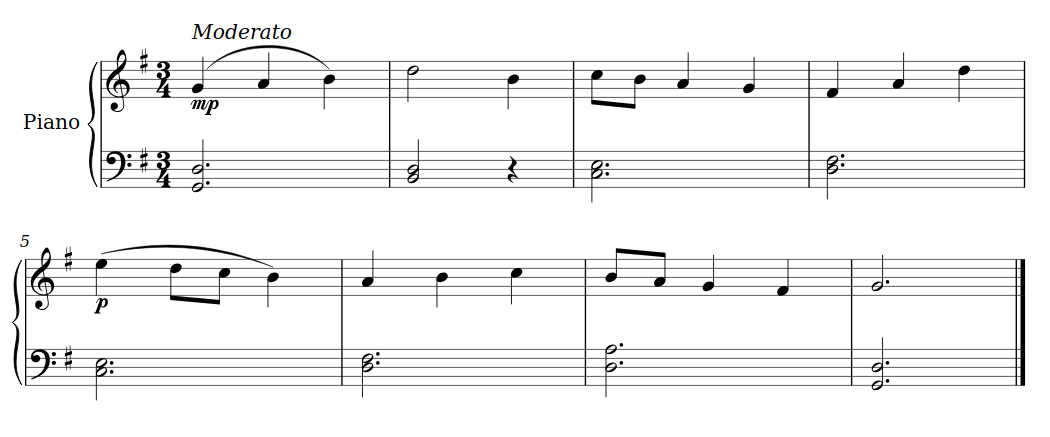
After playing: open the explanation
- Key and metre
- G major, three quarter-note beats per bar. The key signature applies F sharp to both hands and to every octave.
- Bars 1–2
- The right hand rises G–A–B, then reaches D. That D lasts two beats. The left hand holds G and D for three beats in bar 1, then B and D for two beats in bar 2, resting on beat three.
- Bars 3–4
- Bar 3 begins with two eighth notes, C–B, followed by quarter notes A–G. Bar 4 rises F sharp–A–D over a sustained left-hand D and F sharp.
- Bars 5–6
- The new phrase begins piano. Bar 5 has a quarter-note E, two eighth notes D–C, then a quarter-note B. Bar 6 rises A–B–C. The left-hand pairs are C with E, then D with F sharp.
- Bars 7–8
- The right hand moves through eighth notes B–A, then quarter notes G–F sharp, before its final three-beat G. The left hand moves from D with A to G with D. Hear the full duration of the final dotted half note.
Keep the long left-hand sounds alive through the right-hand eighth notes. A habit of moving both hands together can shorten the bass unintentionally. Choose one bar from your first attempt and examine its durations and movement.
What the first reading tells you
Listen once before correcting anything. Could you hear the metre through the whole passage? Did the long notes last their full value? Did the quieter phrase sound different from the opening? These questions describe the performance more usefully than a single verdict of “good” or “bad.”
Next, find the first point where the flow changed. Read the preceding beat as well as the troublesome one. A late hand movement may have been caused by a missed opportunity to prepare it; the difficulty was already developing before the wrong note sounded.
Suppose the right hand was accurate but the left-hand sound disappeared whenever the melody moved. That suggests a coordination habit: both hands are releasing together. Practise one bar with the bass held and the melody played slowly above it. Listen for the sustained lower sound between the upper notes, then restore the original pulse.
If the rhythm slipped instead, speak or tap that bar before returning to the keys. A pitch-reading problem asks for another response: identify the starting note and the pattern of intervals. Give the observed difficulty its own attention, rather than playing the complete study repeatedly and hoping the passage settles.
A second attempt measures what you learned from this example. To discover whether the change transfers to sight-reading, use another unfamiliar passage with a similar feature. Once the notes are remembered, the task has become preparation of a piece.
After a wrong note
A single wrong pitch need not pull the whole phrase backwards. Hear where you are in the beat, locate the next notes and continue. Returning to repair the previous note adds another event to the rhythm and can make the following bar harder to find.
There is a distinction between a slip and losing your place completely. If the page no longer makes sense, find a recognisable point, establish where its beat begins and resume. Randomly moving the fingers in order to appear continuous produces neither a readable rhythm nor a convincing pitch outline.
Recovery is worth practising in unfamiliar music. After an isolated error, resist the automatic restart and finish the phrase. Afterwards, return to the score to find the cause. You are learning to maintain a musical direction while also preserving the habit of correcting problems in practice.
I prefer the instruction “hear the next beat” to “never stop.” It gives the player something musical to attend to. It also leaves room for the practical judgment needed when the connection between the page and the keyboard has genuinely been lost.
What earns the marks
Sight-reading carries a maximum of 21 marks in a Practical Grade. The published bands are 14–16 for a Pass, 17–18 for a Merit and 19–21 for a Distinction in this component. The criteria consider continuity, rhythm, pitch and key, musical detail and the security of the presentation.
There is no useful “one wrong note equals one lost mark” calculation. Read the descriptors as a picture of the performance. An uninterrupted reading with the wrong rhythm throughout has a different problem from a mostly accurate reading interrupted by several restarts. Both deserve attention in preparation.
Musical detail belongs in the first reading too. A softer phrase, a slur or a clear ending can emerge from the notation as you play. Treating expression as something to add only after all the notes are learned leaves out part of what sight-reading asks a musician to do.
Our guide to ABRSM Merit marks and examiner feedback explains how the individual components relate to the complete result. The original study here is for exploration and diagnosis; its performance cannot predict an exam mark.
Preparing with fresh music
Keep a supply of short unfamiliar pieces at an appropriate level. Official specimen books offer examples of the exam format; other suitable music broadens the experience of styles and textures. Playing something easy enough to hear as a whole is valuable alongside work closer to the examination standard.
Separate two kinds of practice. In a first reading, give the passage a brief preparation and carry it through. In focused practice afterwards, stop, compare, repeat and correct the feature that caused trouble. Each has a purpose, and the distinction prevents a small sight-reading exercise from becoming another piece learned by repetition.
The ten-minute sight-reading routine offers a structure for regular work between these exam-style attempts. Over time, compare fresh readings for specific changes: fewer broken phrases, more reliable bass durations, clearer rhythm, or earlier recognition of a new hand position.
A successful preparation period leaves you with something to hear: the metre, the movement of the phrase and the important change ahead. Those impressions carry into the first note. They are the beginning of the performance.