
ABRSM Piano Aural Tests, Grades 6–8: What to Listen For
ABRSM aural tests at Grades 6–8 ask a pianist to listen selectively: follow a particular voice, retain a phrase, hear how harmony moves and describe musical features. The tasks change with each grade. Preparing only to recognise a tune or name a cadence leaves some of the most interesting listening work untouched.
At the piano, the hands can carry a passage long after the ear has stopped following every part. I find aural work valuable because it reverses that relationship. Before finding a sound with the fingers, you have to know what you heard and what you want to reproduce.
This guide maps the main differences between the three grades, then explores the listening behind them. An original two-voice exercise lets you try following the lower part, with the score and answer kept out of sight until you have responded. These are Practical Grade tasks; see the Practical and Performance Grade comparison if you are choosing an exam route.
The tasks by grade
Use the current specification for the full requirements of your chosen grade. The overview below shows where the emphasis changes. In the memory task, a pianist may sing or play the requested part; the task from notation requires singing.
How the tasks change
Grade 6
- Memory: sing or play
- Upper of two parts
- From notation: sing
- Melody with accompaniment
- Harmony
- Perfect or imperfect cadence
- Features and rhythm
- Two announced features; rhythm clap-back; metre in two, three or four.
Grade 7
- Memory: sing or play
- Lower of two parts
- From notation: sing
- Upper of two parts
- Harmony
- Perfect, imperfect or interrupted cadence; two root-position chords; modulation from major
- Features and rhythm
- Two announced features; rhythm clap-back; metre including 6/8.
Grade 8
- Memory: sing or play
- Lowest of three parts
- From notation: sing
- Lower of two parts
- Harmony
- Four cadence types, including plagal; three chords with inversions; modulations from major and minor
- Features and rhythm
- Describe the piece’s characteristic features independently.
One change deserves particular attention: the part you must remember moves down through the texture. A listener who automatically follows the highest line needs to practise directing the ear elsewhere. Another change is the increasing independence of the spoken response. Describing a piece involves choosing which features matter, as well as knowing their names.
For a sung response, ABRSM assesses pitch rather than vocal quality. Use a comfortable range; the official guidance allows an appropriate octave and responses such as humming. The aim is to communicate the musical line. Any access arrangements should be checked through ABRSM’s official guidance for your exam.
Hearing one voice among others
Begin by giving the requested line an identity. Hear its starting pitch, its register and the way its first few notes move. “Lower” is a location in the texture, but the line also has its own rhythm and direction. Following that movement is more reliable than repeatedly reminding yourself to ignore the melody above it.
During a first listening, attend to the broad shape: a rise, a repeated note, a leap or a long arrival. During the second, check the place that was unclear. Trying to memorise a sequence of unrelated pitch names can occupy so much attention that the next phrase passes unheard.
Rhythm belongs to the memory. If a note is held while the other voice continues, keep hearing the held sound internally. It has not disappeared merely because it has stopped producing new attacks. This is especially useful for pianists accustomed to noticing a part only when a finger moves.
In practice, play a two-part passage and sing one line while the other sounds. Then change the assignment. The exercise is revealing: a line that seems obvious under the hand may be surprisingly difficult to maintain with the voice when another part competes for attention.
Try a lower-voice exercise
The following four-bar phrase focuses on the listening required for Grade 7’s memory task. It is original practice material, not an official specimen. Keep the answer closed, listen to the complete clip, then sing or play the lower voice. The clip supplies two listenings, with a count-in before each.
Notice what you retain naturally. Perhaps the beginning is clear but the leap near the end is vague. Perhaps the pitches return accurately but one long note becomes too short. Those are different observations, and they suggest different ways to practise afterwards.
Follow the lower voice
G major, in 3/4. A chord and the lower starting note come first, followed by a two-bar count-in. The two-voice phrase plays twice. Afterwards, sing or play the lower voice from memory.
Open the audio file (MP3)Original Vienna Piano School study, played with synthesized tones.
After answering: reveal the score and lower voice
The lower line rises G–A–B, then holds C for two beats before returning to B. Bar 3 is A–D–F sharp; the final G lasts three beats. The opening G is below middle C. The range is D3 to C4, where C4 is middle C.
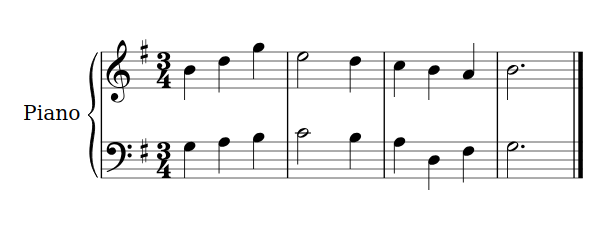
The lower voice alone
Open the lower-voice audio (MP3)If the downward leap in bar 3 was unclear, sing that bar, then approach it from bar 2. Also check whether the two-beat C kept its full duration, even if you remembered the pitches.
After comparing your response with the answer, listen to the full texture once more while following the lower line. Then put this example aside and try a new one. Learning this particular phrase is useful, but the listening skill has to transfer to music you have not yet memorised.
Singing from notation
Singing a line from a score asks for a connection between the written interval and the sound you expect. A pianist can sometimes find the correct key without hearing the pitch in advance. Singing makes that missing step audible.
Start with the key as a musical setting. Sing a short scale or tonic arpeggio in practice, then place the first note within it. The point is to feel how the note relates to the tonal centre, so that the next interval has somewhere to lead. A sequence of intervals becomes a melody when it retains that centre and its rhythmic shape.
When another part accompanies the voice, it can support the harmony while also drawing attention away from the line being sung. Practise your line alone first, then add the other part. Listen for the moments when a different note in the accompaniment tempts the voice to follow it.
I like to pause practice just before such a moment and ask for the next sung note without playing it. That small gap reveals whether the note is already present in the ear. Once it is, continue through the passage at a steady pace. Repeatedly allowing the piano to supply every answer trains recognition after the event, rather than anticipation.
The sight-reading preparation guide discusses pulse and looking ahead at the keyboard. In sight-singing, the voice replaces the fingers, but the need to understand the next rhythm and the direction of the phrase remains.
Cadences, chords and bass notes
A cadence is a harmonic arrival, heard in the context of a phrase. Learn its sound through complete musical sentences as well as isolated pairs of chords. The approach can explain why a particular ending feels conclusive, suspended or redirected.
In C major, play G major followed by C major and sing the bass G–C. Then play G major followed by A minor, singing G–A. Compare the endings while keeping the preceding phrase similar. The contrast is between a dominant-to-tonic arrival and a move from the dominant to the submediant, conventionally called an interrupted cadence in this setting.
Now compare F major followed by C major. That is a different route to the tonic, commonly described as plagal. Finally, end a short phrase on G major and listen to the expectation that remains. In this tonal context, an ending on the dominant is an imperfect cadence. Hearing these movements in several keys prevents a label from becoming attached to one memorised keyboard shape.
For chord identification, distinguish the bass note from the root. C–E–G and E–G–C contain the same pitch classes, but the lowest note changes their position. Sing the bass, then name the chord. If you identify the chord first and assume its root must be underneath, inversions can pass unnoticed.
The word “perfect” can also cause confusion. In the ABRSM context, it names the cadence type; it is not a promise that every note has been played flawlessly. Terminology learnt in another country or theory system may use different labels. Practise attaching the required term to a sound you can demonstrate at the keyboard.
Hearing a modulation
A changed note is evidence to investigate, not proof that the music has settled into a new key. A chromatic note may colour a chord or point briefly towards another harmony. Listen for the place that begins to feel like a new home, especially at the phrase ending.
Keep the original tonic in your memory while hearing the new arrival. From C major, a convincing close in G major has a different relationship to the opening from one in F major or A minor. Playing those destinations yourself, after a short opening in C, gives the relationships a sound before you have to name them in unfamiliar music.
Try singing the original tonic after the passage finishes, then the new tonic. If the original pitch has vanished completely, practise with shorter examples. If both tonics are clear but the label is uncertain, work on the relationship between the keys. Listening and naming are connected skills, but a mistake in one need not mean the other was absent.
Avoid relying on mood alone. A darker passage does not automatically establish a minor key, and a brighter register does not establish the dominant. Support the impression with the bass movement, the altered pitches and the harmony at the arrival.

Describing what matters
A useful spoken answer connects an observation to a place in the music. “It was loud and fast” may be accurate but leaves the listener wondering whether anything changed. “The quiet opening returned more strongly at the end” describes both a dynamic relationship and part of the structure.
Texture is the relationship between the parts. Was there a melody over accompaniment? Did similar ideas enter in different voices? Did a chordal passage give way to a single line? Choose a feature that you can point to in what you heard, rather than listing every texture word you know.
Structure concerns the organisation of the passage. A return, a contrasting middle or a repeated rhythmic idea can provide a useful starting point. You can describe an audible return without forcing a short extract into a large formal label that its length does not support.
Style and period need musical evidence too. Articulation, rhythm, texture, phrase design and harmony can contribute to a judgment. One ornament or a pedal colour on its own is a weak basis for dating a passage. Build the explanation from several audible features and avoid guessing a composer’s name when the task concerns style.
For practice, record a twenty-second spoken response after listening to a short piece. Listen back for empty adjectives and replace one with an observation: where did the register change, which voice carried the tune, or what happened when the opening returned? The response should sound like someone describing music to another musician.
Rhythm and metre
Clapping back a rhythm means preserving the pattern of attacks and durations. Identifying the metre means hearing how the beats are grouped. These are related, but an accurate clap-back does not automatically prove that you have heard the grouping.
At the keyboard, try placing the same short rhythm over different bass patterns. A bass that marks three beats gives a different setting from one that groups two broad beats. For compound metre, feel the larger beat and its subdivisions together; six eighth notes in a bar need not feel like six equal main beats.
Keep a quiet bodily sense of the main pulse as you listen, without turning every subdivision into a heavy accent. When reproducing the rhythm, the grouping should still be perceptible. If the pattern becomes correct only after several repetitions, return to a fresh short example to test the first-listening skill.
Turning feedback into practice
Aural tests are assessed as a whole, out of 18. The published criteria concern accuracy, musical awareness and the security of the response. Counting imagined deductions for each hesitation is less useful than identifying which listening task repeatedly causes difficulty.
If memory fails, shorten the phrase and retain its contour and rhythm. If the wrong voice attracts your attention, practise singing a part against another. If chord labels are uncertain, play and sing the bass of several positions. If the spoken answer stays vague, describe one change precisely. Each task deserves work that matches the difficulty.
Use official practice resources to become familiar with the format, and use ordinary repertoire to keep the listening musical. A bass line in Bach, a change of harmony in Schubert or a returning phrase in Mozart can all become material for a short aural question. The skill is valuable long after the exam: hearing what the score asks for, what the hands produce and where the music is going.